W3C DID (Decentralized Identifiers)
Unlike traditional identity models, where digital identities are stored and controlled by intermediary platforms, W3C DID empowers users to own, manage, and decide how their digital identities and personal data are used.
What Is W3C and Its Role in the Modern Internet
W3C, the World Wide Web Consortium, is a non profit international standards organization that brings together governments, technology companies, research institutions, and expert communities worldwide. W3C does not own or operate the Internet. Instead, it defines open technical standards to ensure the Internet develops in a unified, interoperable, and sustainable way.
Thanks to W3C standards such as HTML, CSS, and other web standards, the Internet can operate across borders without dependence on any single platform, company, or country. This philosophy of open standards, multi stakeholder consensus, and long term interoperability has enabled the Internet to become a truly global infrastructure.
At the core of W3C’s impact is its standards development process. Every proposal goes through open discussion, technical review, and broad consensus before being finalized. As a result, W3C standards function as shared rules for the entire Internet ecosystem.
From the Traditional Web to Digital Trust Infrastructure
In the era of the traditional web, standards like HTML and CSS ensured consistent content display across browsers and devices. These standards laid the foundation for an open, accessible, and platform independent Internet.
As the Internet evolves into a data driven web, the challenge is no longer limited to content presentation. It now centers on verifying identity, data, and trust. This shift has led to the emergence of new W3C standards focused on digital identity and data verification.
W3C DID as the Foundation of Decentralized Identity
Decentralized Identifiers, or DIDs, are a standard that allows individuals and organizations to own decentralized digital identifiers without relying on centralized databases operated by platforms or intermediaries. DIDs can be cryptographically verified while remaining independent of centralized control.
Working alongside DIDs is the W3C Verifiable Credentials standard. Verifiable Credentials enable information such as identities, academic degrees, licenses, or legal status to be issued as independently verifiable digital data that cannot be altered or forged. More importantly, Verifiable Credentials allow users to control how their information is shared, ensuring the right data is shared in the right context and for the right purpose.
W3C DID in Digital Trust Infrastructure and the Trust Economy
From HTML and CSS to DIDs and Verifiable Credentials, W3C standards follow a consistent philosophy. Standardization enables interoperability. Openness supports innovation. Technology establishes trust. Together, these principles form the foundation of the trust economy, where data is not only stored but also verifiable and reliable.
Building on this foundation, digital infrastructures such as NDAChain, the national blockchain platform, implement digital identity and data verification systems in compliance with W3C DID standards. This ensures international interoperability and long term sustainability.
Implementing W3C DID Standards Across the NDAChain Ecosystem
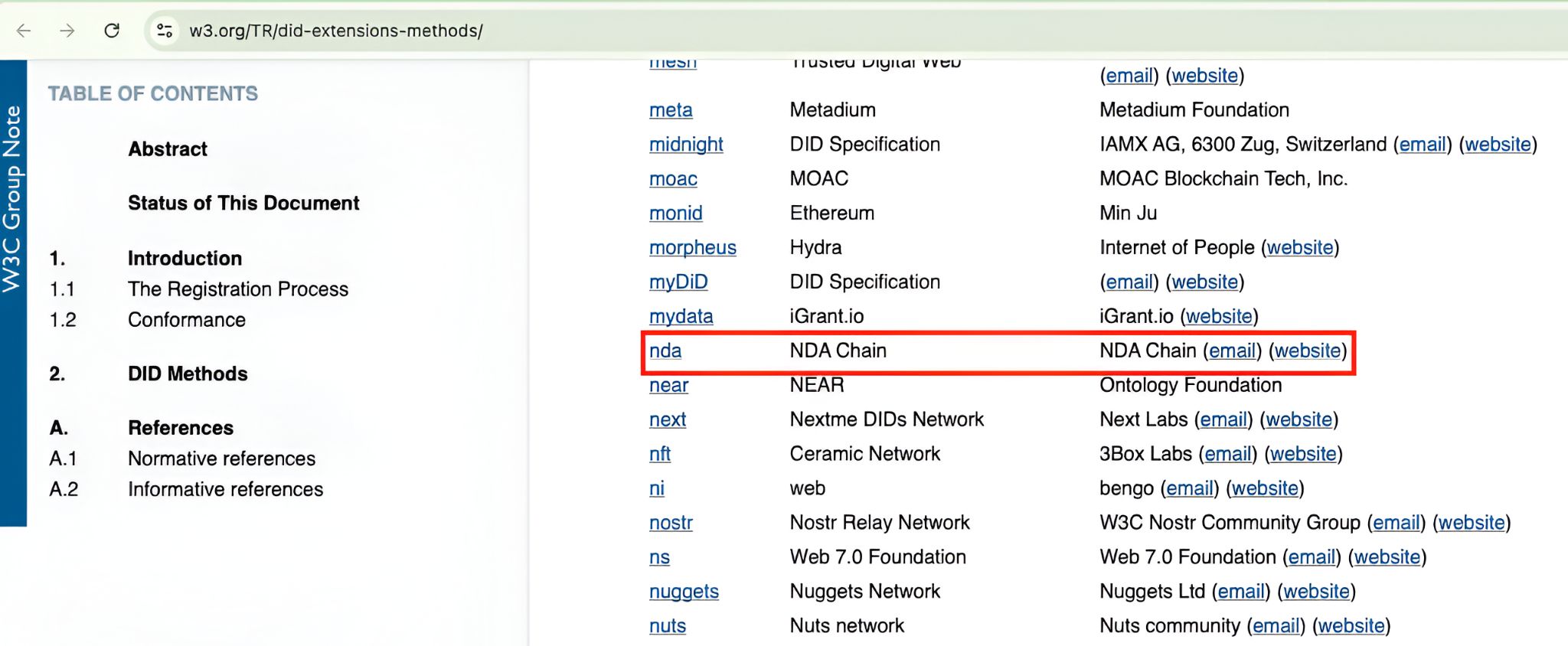
NDAChain demonstrates technological sovereignty on a foundation aligned with the global W3C DID framework.
On NDAChain, NDAKey and NDATrace are designed as two core application layers that share a common technical foundation based on W3C standards. This approach ensures that digital identity and traceability do not operate in isolation, but together form a unified digital trust infrastructure.
Both NDAKey and NDATrace use W3C DID to identify all participants within the ecosystem. DIDs are registered on NDAChain, ensuring uniqueness, integrity, and independent verifiability, while allowing each entity to self manage its own digital identity.
Built on the DID layer, data is issued as Verifiable Credentials and Verifiable Presentations in accordance with the W3C JSON LD standard. Verifiable Credentials are digitally signed using ECDSA and can be integrated with Zero Knowledge Proofs, enabling information to be verified without disclosing the underlying raw data.
W3C as the Standardization Foundation for the National Digital Trust Infrastructure
NDAChain’s compliance with and implementation of W3C standards is not merely a technical choice, but a strategic direction for the national digital trust infrastructure. By combining decentralized identity, verifiable data, and blockchain on an open standards foundation, the Internet evolves beyond system connectivity to become a trust enabling infrastructure that is transparent, verifiable, and ready to integrate into the global digital economy.