The fake credential crisis and integration pressures in 2026
The scale of the problem in Vietnam
During 2024–2025, numerous cases involving fake professional licenses were uncovered across sectors including healthcare, pharmaceuticals, construction, and accounting. This is not merely a legal issue it poses direct risks to public safety, as unqualified individuals can still perform medical procedures or sign off on critical technical works.
🔑 Read more: How Layer 1 Blockchain solves diploma fraud in digital eEducation?
The root cause lies in how verification currently works. Credential lookup still depends on separate information portals maintained by individual ministries, resulting in fragmented data, slow verification, and virtually no mechanism to detect forged scans. When a credential is submitted as a file, the receiving party has almost no way to verify it instantly, and the final decision still relies on subjective trust.
Pressure from ASEAN MRA and the regional labor market
Vietnam has signed 8 Mutual Recognition Arrangements (MRAs) with ASEAN covering: accounting, architecture, engineering, nursing, medicine, dentistry, tourism, and surveying. However, practical effectiveness remains limited due to the lack of a shared digital infrastructure for real-time credential verification. Mutual recognition still depends on manual verification processes that are slow and lack synchronization across countries.
With the ASEAN Digital Economy Framework Agreement (DEFA) expected to be finalized by end of 2026, demand for cross-border interoperability and professional credential verification will surge significantly. This creates an urgent requirement: Vietnam needs an internationally compliant infrastructure to ensure competitiveness and keep pace with the regional labor market.
Why professional licenses need a new infrastructure
Limitations of the current verification system
Each licensing authority currently operates its own separate database. The Ministry of Health manages medical practice licenses, the Ministry of Construction manages civil engineering licenses, and the Ministry of Finance manages auditing practice licenses. Citizens and businesses must access each portal separately, with no mechanism to guarantee that the data displayed is the original, unrevoked record.
Centralized systems also create a single point of failure if one portal is attacked or internally altered, the integrity of all credentials it holds comes into question. This is a significant risk for a category of data that directly affects the lives and assets of citizens.
Requirements for a new infrastructure
A proper digital professional license infrastructure must simultaneously meet four criteria: absolute authenticity (tamper-proof), instant verifiability at every touchpoint, international interoperability via open standards, and protection of credential holders' privacy. These are the four criteria that the Verifiable Credentials (VC) model on permissioned blockchain is designed to address.
🔑 Read more: Decentralized identity as a global trend in the digital era
Verifiable credentials - the next-generation "digital professional passport"
The three-party verification model
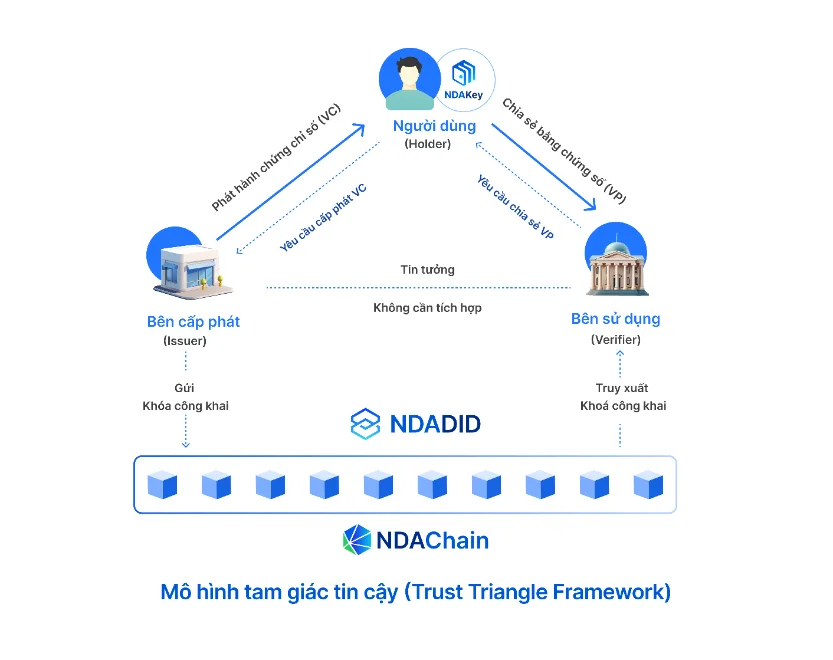
Verifiable Credentials (VCs) are an international standard published by the W3C, describing an electronic credential that can be verified cryptographically. A VC is issued by an authorized entity (Issuer), given to the credential holder (Holder), and can be verified by any checking party (Verifier) without needing to contact the Issuer directly.
When applied to professional licenses, the model works as follows: the Ministry of Health acts as the Issuer, issuing a VC medical practice license to a doctor (Holder); a private hospital or patient (Verifier) can scan a code from the VC and immediately know whether that license is still valid, which authority issued it, and when it expires all within seconds and without logging into the Ministry's lookup portal.
The role of W3C DID and the national blockchain
Verifiable Credentials operate based on the Decentralized Identifier (DID) standard from W3C to identify all parties involved. In this model, the credential-issuing authority (Issuer), the credential holder (Holder), and the verifying party (Verifier) each have their own DID. Each credential is digitally signed using the Issuer's private key, ensuring authenticity and making forgery impossible.
The national blockchain serves as the trusted infrastructure layer, where DIDs are registered and the validity or revocation status of each VC is recorded. As a result, any verifying party can independently check a credential's validity without having to access the issuing authority's lookup portal.
This is a key distinction from traditional electronic certificates. A digitally signed PDF only proves that the document has not been altered, but does not indicate whether the credential is still valid or has been revoked. VCs on national blockchain infrastructure solve both problems simultaneously: authentication and real-time status checking.
🔑 Read more: What is W3C DID? Why does the Internet need a Decentralized Identifier Standard?
NDAChain - infrastructure for digital professional licenses in Vietnam
Hybrid DID model suited for licensing authorities
NDAChain is designed around a Hybrid DID model, combining state-led centralized governance, decentralized verification, and user-controlled data ownership. This architecture is particularly well-suited to the professional licensing challenge, where credentials must be issued by authorized authorities while still enabling independent verification and broad interoperability.
The model consists of three layers:
Centralized authority: The National Data Center and regulatory agencies serve as official issuers
Decentralized verification: A network of Validator Nodes distributed across multiple regions ensures transparency and eliminates dependence on a single control point
User sovereignty: Individuals own and manage their credentials through a digital identity wallet
On NDAChain, each ministry can be assigned an authority DID to issue Verifiable Credentials using the did:nda method. This allows professional licenses to retain the full legal standing of the issuing authority, while being instantly verifiable to international standards, without relying on a single centralized lookup portal.
🔑 Read more: NDAChain positions Vietnam among Asia's pioneering nations in decentralized identity under the W3C DID standard
Domain chains specialized for each industry
Under NDAChain's Rootchain-Centric Hierarchical Multichain architecture, each sector can operate its own Domain Chain to handle industry-specific workflows while inheriting the verification and trust layer from the Root Chain.
Examples:
Healthcare Domain Chain: manages medical practice licenses, specialist certifications, vaccination records
Construction Domain Chain: manages engineer, architect, and site supervisor licenses
Finance and accounting Domain Chain: manages auditor and practicing accountant licenses
Domain Chains are connected through ChainHub, enabling verification and data exchange via Verifiable Presentations in accordance with the W3C standard. This means an individual holding multiple credentials across different fields can present their entire digital professional portfolio in a single verification.
This architecture allows each sector to maintain operational specialization while ensuring cross-system interoperability and verification at national scale.
NDA SFS protects associated sensitive data
Many professional licenses contain more than basic information, they also come with sensitive data such as training records, examination results, reissuance history, or professional disciplinary records. This is a category of data that requires high verifiability while demanding absolute privacy.
NDA Secure File System (NDA SFS) on NDAChain is designed for this use case using a Zero-Trust model. Data is end-to-end encrypted from the user's side, storage nodes cannot read the original content, and access rights are controlled through Verifiable Credentials issued by the credential owner themselves, revocable in real time.
As a result, professional licenses not only verify legitimacy but also allow sharing strictly within the required scope, protecting personal data while maintaining verifiability to national and international standards.
🔑 Read more: NDAChain the trusted data backbone for Vietnamese enterprises
Real-world benefits for all stakeholders
Citizens and users of professional services
Citizens can instantly verify the validity of a professional license with a single QR scan. Whether it's a doctor, architect, or accountant, information about the issuing authority, expiry date, and revocation status can all be confirmed within seconds.
The lookup process no longer depends on logging into a portal or waiting for manual confirmation, significantly reducing the risk of using services from unqualified practitioners.
Licensing authorities and professional associations
Regulatory bodies can monitor the full lifecycle of credentials in real time: issuance, renewal, suspension, or revocation are all recorded with tamper-proof timestamps and digital signatures.
This not only increases transparency but also makes workforce statistics and management more accurate, reducing reliance on manual data consolidation from multiple agencies.
Employers and international partners
Employers can verify a candidate's credentials during the hiring process, reducing the risk of fraudulent applications or misrepresentation.
For international markets, credentials issued under the W3C DID/VC standard can be verified across borders without the need for notarization or supplementary confirmation letters. This is a critical foundation for enabling Vietnam's skilled workforce to participate more deeply in regional and global markets.
Implementation roadmap and lessons from the EU and Singapore
The European Union deployed the European Blockchain Services Infrastructure (EBSI) for digital diplomas and credentials starting in 2022. By 2026, more than 100 universities across Europe had issued academic degrees as Verifiable Credentials. Singapore has operated the OpenCerts platform since 2018 and expanded it to vocational skill certifications under the SkillsFuture program.
Vietnam has the advantage of being a late mover while adopting international standards from the outset. Rather than rebuilding from scratch, Vietnam can draw on the standardization experience from EBSI and OpenCerts while deploying on a nationally operated blockchain infrastructure.
A suitable roadmap is structured in phases: piloting selected professions in 2026, expanding to multiple sectors in 2027, then enabling ASEAN MRA credential interoperability and university degree recognition from 2028. This is a measured but sufficiently fast approach to keep pace with the region's digital transformation.
🔑 Read more: NDAChain - Blockchain Layer 1 Make in Vietnam
Digital trust for Vietnam's workforce
When every professional license can be instantly verified, tamper-proof, and interoperable to international standards, Vietnam doesn't just solve the fake credential problem, it builds an entirely new foundation of trust for its highly skilled workforce.
This is not simply about digitizing paperwork. It is a transformation in how professional skills and competencies are recognized in the digital era, one where a Vietnamese doctor, engineer, or accountant can carry their "digital professional passport" to work, verify, and connect anywhere in the world.
In this vision, NDAChain - with its Rootchain-Centric Hierarchical Multichain architecture, Hybrid DID model, and NDA SFS storage layer, is built as the foundational infrastructure for digital professional licensing in Vietnam, supporting ministries, professional associations, and enterprises in deploying a trustworthy verification ecosystem at national and regional scale.
👉 Contact NDAChain to explore how to implement digital professional licensing for your agency, association, or enterprise: https://ndachain.vn/en