
What Is a Layer 1 Blockchain Consensus Mechanism, and Why Does It Matter?
A consensus mechanism is the method by which nodes in a blockchain network agree on the state of data, validate the legitimacy of transactions, and add new blocks to the chain. If a blockchain is a "distributed ledger," then the consensus mechanism is the rulebook that decides who is allowed to record entries, when they may do so, and how to ensure no one cheats.
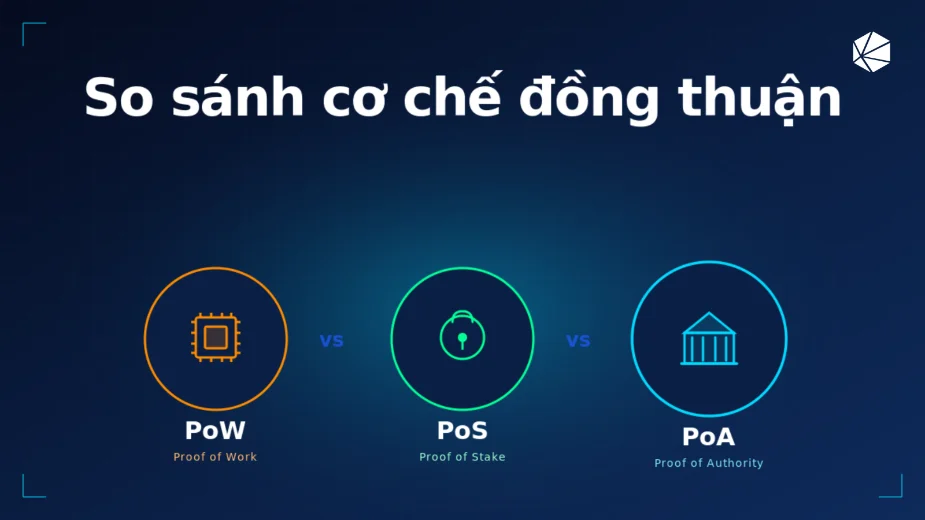
The importance of a consensus mechanism rests on three core pillars:
Security: protecting the network from attacks and data manipulation.
Performance: determining transaction processing speed, block creation time, and scalability.
Decentralization: the degree to which control is distributed among network participants.
Today, the three most common consensus mechanisms in the global Layer 1 blockchain ecosystem are:
Proof of Work (PoW): The Pioneering Mechanism, an Energy Equation
How it works
Proof of Work requires validator nodes (commonly called "miners") to solve complex cryptographic puzzles to earn the right to add a new block to the chain. This process demands enormous computational power, and the node that solves the puzzle first receives a token reward.
Bitcoin, the first Layer 1 blockchain, has operated on PoW continuously since 2009, demonstrating outstanding security through more than 15 years of uninterrupted operation without ever being successfully attacked.
Strengths
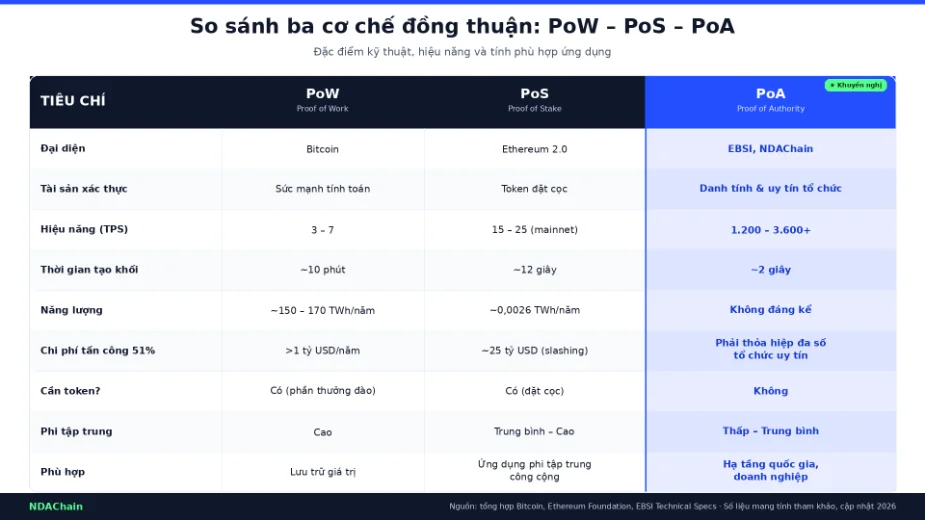
PoW's most prominent advantage is its proven, high level of security. To attack the Bitcoin network (a so-called 51% attack), a malicious actor would need to control more than 50% of the network's total computing power, with estimated costs exceeding USD 1 billion per year. PoW also delivers genuine decentralization, since anyone with suitable hardware can participate in validation.
Limitations
That same massive computational requirement is also PoW's greatest weakness. The Bitcoin network currently consumes around 150–170 TWh of electricity per year, comparable to the consumption of some mid-sized countries. Performance is another serious bottleneck: Bitcoin processes only 3–7 transactions per second (TPS), with a block time of around 10 minutes. These figures are far too low for any national digital infrastructure that needs to handle millions of transactions daily.
Proof of Stake (PoS): Energy-Efficient and More Scalable
How it works
Proof of Stake replaces computational power with staked assets. Validator nodes must lock (stake) a certain amount of tokens as "collateral." The system randomly selects validators based on the size of their stake and other factors. If a node behaves dishonestly, its stake is confiscated (slashing).
Ethereum, the world's second-largest Layer 1 blockchain, transitioned from PoW to PoS in September 2022 in an event known as "The Merge," marking the most significant turning point in blockchain history.
Strengths
The results of The Merge were striking: Ethereum's energy consumption dropped by 99.95%, from tens of TWh to roughly 0.0026 TWh per year, equivalent to that of 200–250 American households. Performance also improved significantly, reaching 15–25 TPS on mainnet and scaling to thousands of TPS when combined with Layer 2 solutions. The cost of a 51% attack on a PoS network is estimated to be around 25 times higher than that of an equivalent PoW network, because an attacker not only incurs costs but also forfeits all of their staked assets.
Limitations
However, PoS has one feature that gives governments pause: it is inseparable from a token. Participating in validation requires holding tokens, and tokens are subject to speculation and price volatility, creating both financial and legal risks. Validation power also concentrates in the hands of those who hold the most tokens, raising the risk of a "rich get richer" dynamic in network governance. For a national infrastructure serving more than 100 million citizens, dependence on a token market is a risk that is difficult to accept.
Proof of Authority (PoA): A Strategic Choice for National Blockchains
How it works
Proof of Authority replaces both computing power and staked assets with the identity and reputation of validators. Validator nodes are organizations with verified identities, clearly delegated authority, and legal accountability for their actions. There are no puzzles to solve and no tokens to stake, the "collateral" is the participating organization's reputation and legal obligations.
Strengths
PoA delivers superior performance compared with both PoW and PoS. PoA networks can achieve thousands of TPS with block times measured in seconds, well-suited to data infrastructure operating at national scale. Energy consumption is negligible, and most importantly, PoA does not require a token, eliminating the risks of speculation and the legal complexity associated with digital assets.
This is why PoA is the preferred choice of most national blockchains and inter-governmental alliances. EBSI, the blockchain infrastructure of all 27 European Union member states, runs on PoA. China's BSN operates on a similar model. And NDAChain, Vietnam's national Layer 1 blockchain infrastructure, uses PoA-qBFT (Proof of Authority combined with Byzantine Fault Tolerant), optimized to ensure fault tolerance even when a portion of nodes encounters failures.
Limitations
PoA is not without its weaknesses. Its level of decentralization is lower than that of PoW or PoS, since the number of validator nodes is limited and they are appointed rather than open to all. This places strong demands on governance: who is selected as a validator, the process for adding or removing validators, and the mechanisms for monitoring their behavior. Where governance is weak, the system risks becoming "centralization in disguise."
For national infrastructure, however, this is not a drawback but a deliberate trade-off. A national blockchain does not need to allow anyone to participate in validation; it needs reputable organizations with legal accountability operating under a clear governance framework.
Summary Comparison: PoW vs PoS vs PoA
Why Do National Blockchains Choose PoA? Lessons from EBSI, BSN, and NDAChain
When building national digital infrastructure, governments face a set of requirements very different from those of public blockchain markets.
First, performance must match national scale. A country of more than 100 million people, like Vietnam, needs infrastructure capable of processing millions of validation transactions every day, from citizen identity verification and product traceability to credential authentication. PoW at 3–7 TPS, or PoS at 15–25 TPS on mainnet, cannot meet that demand. NDAChain, with PoA-qBFT, achieves 1,200–3,600 TPS with a block time of just 2 seconds and near-instant finality.
Second, no token dependency. Resolution 57-NQ/TW and Decision 1131/QĐ-TTg position blockchain as a national strategic technology, but within a data-infrastructure framework, not a digital-asset market. PoA enables blockchain operation without issuing a token, completely avoiding legal and speculative risks.
Third, clear, accountable governance. NDAChain's 49 validator nodes are being developed by state agencies and major enterprises such as SunGroup, Zalo, Masan, MISA, Sovico, and VNVC. Each validator is an organization with a clearly defined legal identity, accountable under Vietnamese law. This model is fundamentally different from the thousands of anonymous nodes found in PoW or PoS networks.
This philosophy is consistent with the approach taken by EBSI in Europe, where 27 member states jointly operate a PoA blockchain network for cross-border public services, and BSN in China, with its state-led governance model.
🔑 Further reading: Vietnam’s National Blockchains and the Foundation of Trust Infrastructure in the Data Economy
2025–2026 Trends: Consensus Mechanisms Are Evolving
The blockchain world is not standing still at the three traditional mechanisms. The 2025–2026 period is witnessing several notable innovations.
Hybrid consensus models, combining the strengths of multiple mechanisms, are emerging in growing numbers. NDAChain is a prime example, combining PoA with qBFT to add a layer of Byzantine fault tolerance, ensuring that the network continues to operate stably even when up to one-third of nodes experience failures or behave abnormally.
Research into quantum-resistant consensus is accelerating, preparing for an era in which quantum computers may threaten today's cryptographic algorithms. The International Monetary Fund (IMF) also published a 2025 report systematizing consensus mechanisms, emphasizing the importance of choosing the appropriate mechanism for national financial infrastructure.
The trend of expanding PoA in the public sector is also becoming increasingly clear, with more than 50 countries having deployed or piloted national blockchain platforms, the vast majority using PoA variants or equivalent permissioned models.
Conclusion
There is no single "best" consensus mechanism for every case, only the most appropriate one for each objective. PoW is well-suited to absolute decentralized value storage. PoS fits public decentralized application ecosystems. PoA, with its high performance, freedom from token dependency, and governance based on legal identity, is the strategic choice for national Layer 1 blockchain infrastructure.
NDAChain, with its PoA-qBFT consensus mechanism, 49 public-private validator nodes, performance of 1,200–3,600 TPS, and compliance with W3C DID and ISO 27001 standards, is proof of how Vietnam is applying a fitting consensus mechanism to build national digital trust infrastructure. Learn more about the NDAChain architecture at: https://ndachain.vn