1. What is the Blockchain Trilemma?
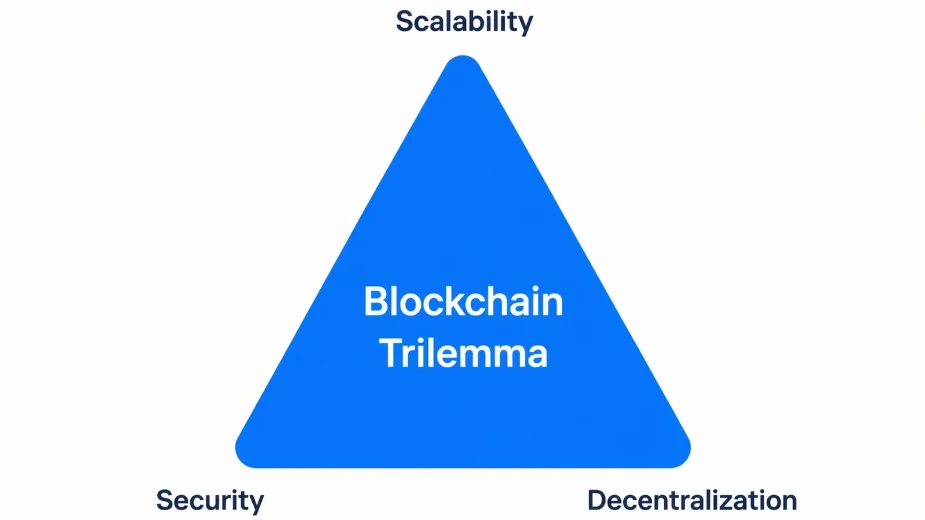
The Blockchain Trilemma (also known as the Blockchain Scalability Trilemma) describes the fundamental challenge in designing a Layer 1 blockchain: it is extremely difficult to simultaneously optimize security, decentralization, and scalability. Improving one characteristic often requires compromising another.
🔑 Read more: Global Blockchain Layer 1 Map 2026: The Position of Vietnam's NDAChain
The three components of the Blockchain Trilemma are:
Security: The ability to resist attacks and fraud while ensuring the integrity and immutability of data.
Decentralization: The degree to which control is distributed among multiple nodes or validators, reducing reliance on any single entity.
Scalability: The capacity to process transactions with high throughput and low latency as the user base grows.
The concept was popularized by Vitalik Buterin and has become one of the most important frameworks for evaluating blockchain architectures. For a national blockchain, the Blockchain Trilemma is not only a technical challenge but also a matter of performance, governance, and data sovereignty at a national scale.
2. The three corners of the triangle and their trade-offs
Security: The foundation of every Layer 1 blockchain
Security is the most critical attribute of a Layer 1 blockchain. If the network can be attacked, data altered, or transactions reversed, the entire value proposition of the system collapses. Security depends on factors such as the consensus mechanism, the number of participating validators, the cost of attacking the network, and cryptographic protections. This is why public blockchains such as Bitcoin accept substantial computational costs to maintain a very high level of security.
Decentralization: Distributing control
Decentralization reflects how widely authority is distributed across the network. The more independent nodes or validators participate in consensus, the harder it becomes for any single entity to control the blockchain. However, increasing the number of participants also raises coordination costs and transaction confirmation times. As a result, public blockchains often prioritize decentralization while sacrificing some performance.
Scalability: Performance at scale
Scalability refers to a blockchain’s ability to process transactions efficiently as the number of users grows. It is commonly measured through TPS (Transactions Per Second) and transaction latency. Traditional public blockchains generally offer lower TPS than centralized payment systems. Improving performance often requires optimizing the consensus mechanism or limiting validator participation, which can reduce decentralization.
The interaction and trade-offs among these three factors form the Blockchain Trilemma, the central challenge in designing any blockchain, whether public or national.
3. Common approaches to addressing the trilemma
According to Ethereum Foundation Layer 2 documentation, the blockchain community is pursuing several approaches to ease these trade-offs:
Layer 2 and Rollups: Move most transactions off the main chain and anchor the data back to Layer 1, increasing throughput while inheriting the security and decentralization of the base blockchain.
Sharding: Divide the network into multiple shards that process transactions in parallel, improving scalability while preserving decentralization.
Alternative consensus mechanisms: Transition from Proof of Work (PoW) to more efficient mechanisms such as Proof of Stake (PoS) or Proof of Authority (PoA) to increase processing speed, reduce operating costs, and improve energy efficiency.
Permissioned models: Restrict validation rights to an approved group of validators with known identities, accepting a lower degree of decentralization in exchange for higher performance, stronger governance, and suitability for national blockchain applications.
Each approach represents a different balance point within the Blockchain Trilemma, depending on the objectives and requirements of a particular network.
🔑 Read more: What is Blockchain Consensus Mechanisms? A complete overview for 2026
4. How does NDAChain balance the trilemma?

NDAChain does not address the blockchain trilemma in the same way as public blockchains. Instead, it redefines the problem based on the requirements of a national digital infrastructure. For public services, priorities are reordered: security and regulatory compliance come first, performance must remain stable at large scale, and decentralization is interpreted as the distribution of authority among government agencies and authorized organizations rather than complete anonymity.
NDAChain’s three core design choices
Security first: NDAChain uses PoA-qBFT (Proof of Authority combined with Byzantine Fault Tolerance), tolerating faults in up to one-third of validators. It also incorporates Zero-Knowledge Proofs (ZKP) and complies with Vietnam Information Security Level 4 requirements and ISO 27001/27701 standards.
Controlled decentralization: The network consists of 49 public-private validators, including the National Data Center, ministries, provinces, and major enterprises. Validation authority is distributed, while every validator has a verifiable identity and legal accountability.
Scalability for national-scale operations: Throughput ranges from 1,200–3,600 TPS, with a 2-second block time, 1.5-second confirmation latency, and near-instant finality providing greater stability and lower costs than many conventional public Layer 1 blockchains.
🔑 Read more: What is PoA-qBFT? The consensus mechanism of NDAChain Layer 1 blockchain
This architecture explains why NDAChain adopts PoA-qBFT for a national blockchain: it is optimized for environments where validators have verified identities and trust is derived from legal authority rather than computational expenditure, as in PoW systems.
5. Why do national blockchains accept a lower degree of decentralization?
Within the Blockchain Trilemma, no model can fully optimize security, decentralization, and scalability simultaneously. For a national blockchain, the priority is building a high-performance digital trust infrastructure that supports accountability and regulatory compliance rather than maximizing decentralization at all costs.
Public blockchains: Prioritize open decentralization, allowing anyone to participate in validation without permission. This model is suitable for digital assets and decentralized applications.
National blockchains: Use permissioned models in which validators are identity-verified and authorized, ensuring governance, accountability, and stable operation at scale.
In NDAChain, validation authority is not concentrated within a single organization but distributed among authorized public and private validators. This approach reduces the risk of unilateral manipulation while ensuring that accountable entities exist to resolve disputes and incidents.
This reflects the philosophy behind national blockchains: selecting the appropriate balance between security, performance, and decentralization rather than maximizing a single characteristic. For this reason, national data infrastructures often favor permissioned architectures that support governance and data sovereignty requirements.
6. The Blockchain Trilemma and the future of national blockchain design

The Blockchain Trilemma is not an absolute limitation but a framework for understanding the trade-offs involved in Layer 1 blockchain design. Every blockchain must answer a fundamental question: which properties should be prioritized to achieve its intended purpose?
For national blockchains, the goal is not to maximize decentralization at any cost, but to build a digital trust infrastructure that balances security, performance, governance, and data sovereignty. Consequently, platforms such as NDAChain adopt a model of controlled decentralization, where validation authority is distributed among independent organizations while preserving legal accountability and national-scale operational capability.
🔑 Read more: National Blockchain – The “Digital Key” to Protecting Consumers
In the future, technologies such as sharding, rollups, multichain architectures, and next-generation consensus mechanisms will continue expanding the possibilities for addressing the Blockchain Trilemma. However, one principle remains unchanged: an effective blockchain is not one that maximizes a single metric, but one that is designed to fit its intended purpose. For national blockchains, this means prioritizing digital trust, performance, and the ability to serve millions of users on a secure and reliable data infrastructure.
Frequently Asked Questions (FAQ)
What is the Blockchain Trilemma?
The Blockchain Trilemma is the idea that a blockchain network cannot easily maximize security, decentralization, and scalability at the same time. At least one factor is usually compromised. The term was popularized by Vitalik Buterin and has become a standard framework for evaluating blockchain designs. For example, Bitcoin offers strong security and decentralization but relatively limited scalability, while many high-speed blockchains sacrifice some decentralization.
What are the three components of the trilemma?
The three components are security, decentralization, and scalability.
Security is the ability to resist attacks and maintain immutable data.
Decentralization measures how widely control is distributed across the network.
Scalability refers to transaction throughput and performance as user numbers grow.
Strengthening one factor often places pressure on the other two.
How does NDAChain address the trilemma?
NDAChain prioritizes security and performance for national infrastructure. It delivers 1,200–3,600 TPS using a Byzantine fault-tolerant PoA-qBFT consensus mechanism, combined with Zero-Knowledge Proofs and national-level information security controls. Decentralization is implemented through a network of 49 public-private validators with verified identities, rather than anonymous participation.
Can the trilemma be completely solved?
The trilemma is not an absolute law but a framework describing trade-offs. Technologies such as Layer 2 solutions, rollups, and sharding help reduce these trade-offs. For example, rollups can significantly increase throughput while inheriting Layer 1 security. However, it remains rare for any blockchain architecture to optimize all three dimensions perfectly at the same time.
Why do national blockchains accept reduced decentralization?
Public services require legal accountability when disputes or incidents occur, unlike anonymous cryptocurrency networks. NDAChain’s permissioned model distributes authority among multiple authorized institutions, providing protection against unilateral control while maintaining accountability. This is not a rejection of decentralization but a form of decentralization designed to support public governance objectives.