What is Zero-Knowledge Proof?
Zero-Knowledge Proof (ZKP) is a cryptographic method that allows one party (the prover) to demonstrate to another party (the verifier) that a statement is true, without revealing any information beyond the validity of that statement.
Consider this scenario: a citizen needs to prove they are over 18 to access an online public service. Traditionally, they would present a national ID card, thereby disclosing their full name, date of birth, identification number, and place of residence. ZKP enables the system to confirm “this citizen is over 18” without knowing the exact date of birth, without storing the ID number, and without accessing any additional data fields.
The concept of ZKP was introduced in 1985 by Shafi Goldwasser, Silvio Micali, and Charles Rackoff in their paper The Knowledge Complexity of Interactive Proof Systems. Over nearly four decades, ZKP has evolved from academic theory into a practical engineering tool and blockchain has become the environment that enables ZKP to operate at scale.
Three conditions of a valid Zero-Knowledge Proof

Every ZKP protocol must simultaneously satisfy three properties:
Completeness: If the statement is true, an honest prover can always convince the verifier. The system never rejects a valid proof.
Soundness: If the statement is false, no dishonest prover can successfully deceive the verifier. The probability of fraud approaches zero.
Zero-Knowledge: The verifier learns nothing beyond the true/false outcome. The original data remains completely undisclosed.
These three properties form the mathematical foundation for blockchain security when integrating ZKP, ensuring that data is accurately verified without being exposed.
zk-SNARKs and zk-STARKs: Two major ZKP branches
In real-world Layer 1 blockchain implementations, two ZKP variants are most commonly used:
zk-SNARKs (Zero-Knowledge Succinct Non-Interactive Arguments of Knowledge)
zk-SNARKs produce extremely small proofs (a few hundred bytes) and enable very fast verification, making them suitable for high-throughput systems. However, zk-SNARKs require an initial trusted setup. If this setup is compromised, the entire system may be at risk.
zk-STARKs (Zero-Knowledge Scalable Transparent Arguments of Knowledge)
zk-STARKs eliminate the need for a trusted setup, replacing it with full transparency. Although proof sizes are larger than zk-SNARKs, zk-STARKs are quantum-resistant, offering a strategic advantage for infrastructures designed to operate over decades.
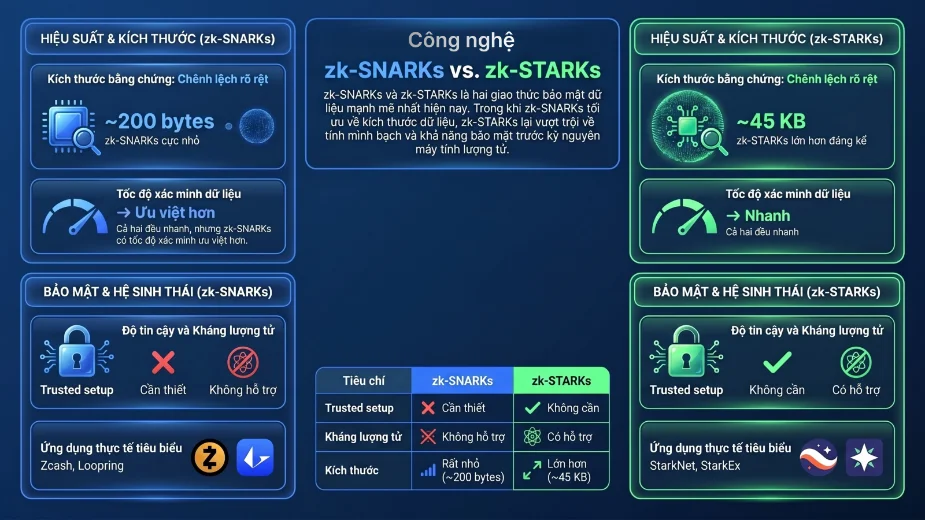
For national Layer 1 blockchain infrastructure, zk-STARKs are often preferred due to their transparency and long-term security guarantees.
How does ZKP operate on Blockchain Layer 1?
On a Layer 1 blockchain infrastructure, ZKP is integrated at the protocol layer, not merely at the application layer. This means every transaction and verification on-chain is protected by ZKP without requiring each application to implement it independently.
The operational process consists of four steps:
Commitment creation: Original data is encoded into a cryptographic commitment (hash commitment) stored on-chain. The actual data never appears on the blockchain.
Proof generation: The prover uses ZKP algorithms to generate a mathematical proof that the data satisfies the required conditions without revealing the data itself.
On-chain verification: A smart contract verifies the proof. This process is computationally efficient, it validates mathematical consistency rather than processing raw data.
State update: The verification result (valid/invalid) is recorded on the distributed ledger, which is immutable and auditable.
This model resolves the transparency–privacy paradox in blockchain systems: the ledger remains transparent and auditable, while sensitive data is fully protected.
ZKP applications on Blockchain Layer 1
Digital Identity Verification
This is among the most transformative applications. With ZKP, a Decentralized Identity (DID) system can verify personal attributes without storing personal data on-chain.
For example, an enterprise needs to verify that an employee holds a valid university degree. Instead of submitting a copy of the diploma, the employee presents a Verifiable Credential (VC) accompanied by a ZKP. The system confirms that the degree is valid without revealing which institution issued it, the GPA, or the year of graduation.
The European Union implements this model through the European Blockchain Services Infrastructure (EBSI), where personal data is not stored on-chain, only cryptographic proofs are recorded. This approach sets the benchmark for national blockchain infrastructures.
🔑Read more: How Layer 1 Blockchain solves diploma fraud in digital education?
Data authentication and legal compliance
Under the 2024 Data Law and the 2025 Personal Data Protection Law, organizations must ensure both data integrity and traceability while safeguarding privacy. ZKP on Blockchain Layer 1 enables compliance with both requirements simultaneously: data integrity is verifiable on-chain, while content remains protected through cryptographic proofs.
A PwC survey indicates that 49% of CEOs view lack of trust as a growth barrier. ZKP rebuilds trust through mathematics rather than reliance on promises or third-party assurances.
Supply chain traceability
In supply chains, each participant holds confidential data: manufacturers protect formulas, distributors protect pricing, and retailers protect margins. ZKP allows each party to prove compliance with standards (origin, storage temperature, organic certification) without disclosing business-sensitive information.
On a Layer 1 blockchain infrastructure, these proofs are recorded immutably, allowing end consumers to verify the entire product journey without exposing any party’s trade secrets.
🔑Read more: Blockchain in traceability: Strategic pillar for Vietnam's digital economy
International Case Studies: ZKP in national infrastructure

EBSI and eIDAS 2.0
The European Union integrates ZKP into digital identity authentication under the eIDAS 2.0 framework. EU citizens use the European Digital Identity Wallet to present Verifiable Credentials that disclose only necessary attributes (age eligibility, EU nationality, valid driver’s license) without revealing complete personal records. This model serves 450 million citizens on a permissioned blockchain infrastructure, without relying on digital assets.
Estonia – X-Road and Blockchain
Estonia has integrated blockchain into its X-Road system since 2012, using cryptographic proofs to ensure data integrity. Estonia’s KSI blockchain demonstrates that national infrastructure can operate securely without storing personal data on-chain, an approach aligned with ZKP principles.
NDAChain and Zero-Knowledge Proof: Digital trust infrastructure for Vietnam
Resolution 57-NQ/TW identifies digital infrastructure development as a national strategic priority. NDAChain—Vietnam’s Blockchain Layer 1 infrastructure is designed with ZKP as a core security layer, serving national data protection and data sovereignty objectives.
Technical architecture supporting ZKP
NDAChain operates on a PoA-qBFT consensus mechanism with throughput of 1,200 TPS and EVM compatibility, capable of processing large volumes of ZKP verification without congestion. This architecture enables:
Fast proof verification: PoA-qBFT finalizes blocks within seconds, ensuring near real-time ZKP validation.
Low and predictable verification costs: No volatile gas fees as seen on public blockchains.
Ecosystem compatibility: EVM compatibility allows ZKP libraries such as Circom, SnarkJS, and Halo2 to be deployed directly on NDAChain.
The did:nda system and Verifiable Credentials
NDAChain implements the decentralized identity method did:nda, registered with the W3C DID Registry. Combined with ZKP, the system enables:
Individuals to present Verifiable Credentials to prove attributes without revealing original data.
Organizations to verify partners, employees, and suppliers without directly accessing personal databases.
Regulators to audit compliance without centrally collecting and storing sensitive data.
This model aligns with the 2025 Personal Data Protection Law: personal data never leaves its source, only cryptographic proofs are verified on-chain. It embodies the principle of national data protection at the protocol level.
ZKP for enterprises on NDAChain
For enterprises, ZKP on NDAChain unlocks three strategic capabilities:
Compliance without exposure: Prove regulatory compliance (tax, environmental standards, product origin) without disclosing internal financial data.
Trustless collaboration: Multiple enterprises within a supply chain can validate shared data without relying on mutual trust ZKP ensures correctness through mathematics.
Protection of trade secrets: Participate in shared data networks without sacrificing competitive advantage.
The future: ZKP and digital trust infrastructure

ZKP is more than a cryptographic technology it is the foundation of a new trust paradigm in the digital economy. Instead of trust based on reputation or institutional authority, ZKP establishes trust through mathematics: anyone can verify; no one needs blind faith.
The 2024 Data Law requires integrity and traceability. The 2025 Personal Data Protection Law requires privacy protection. NDAChain, with ZKP integrated at the protocol layer, is the infrastructure capable of satisfying both requirements simultaneously, creating the digital trust foundation upon which public services, e-commerce, healthcare, education, and supply chains can securely operate.