11 Core National Technology Groups
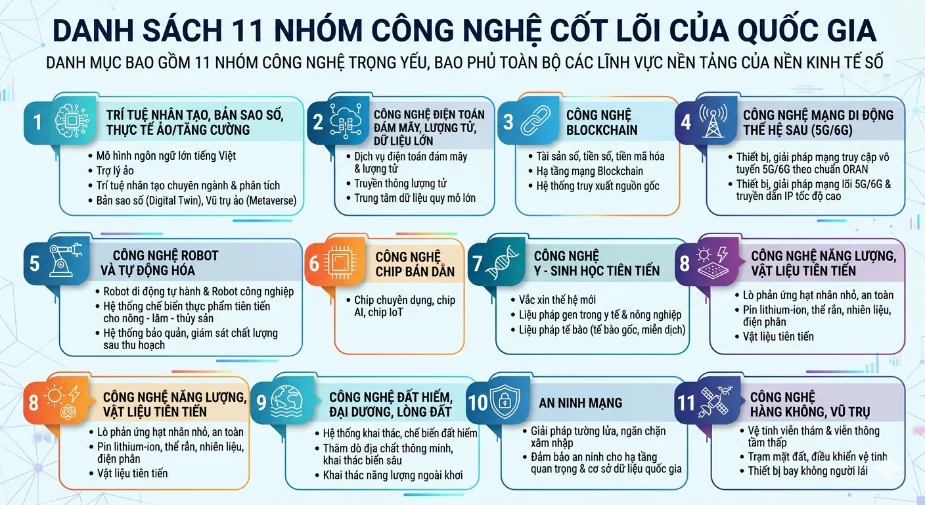
The list comprises 11 vital technology groups covering every foundational aspect of the digital economy:
1. AI, Digital Twin, VR/AR: Vietnamese LLMs, Virtual Assistants, Specialized & Analytical AI, Digital Twin, and the Metaverse.
2. Cloud, Quantum & Big Data: Cloud services, Quantum computing/communications, and Hyperscale Data Centers.
3. Blockchain Technology: Digital assets, Digital currency, Cryptocurrency, Blockchain network infrastructure, and Traceability systems.
4. Next-Gen Mobile (5G/6G): ORAN-compliant Radio Access Network (RAN) solutions, Core network solutions, and High-speed IP transmission.
5. Robotics & Automation: Autonomous Mobile Robots (AMR), Industrial robots, and advanced food processing/post-harvest monitoring systems.
6. Semiconductors: Specialized chips, AI chips, and IoT chips.
7. Advanced Bio-Medicine: Next-gen vaccines, Gene therapy (medical/agricultural), and Cell therapy (stem cells, immune cells).
8. Energy & Advanced Materials: Small Modular Reactors (SMR), Lithium-ion/Solid-state batteries, fuel cells, and advanced materials.
9. Rare Earths & Deep-Sea/Subsurface Tech: Exploration, extraction, and refining systems for rare earths; smart geological survey and deep-sea mining tech.
Cybersecurity: Firewalls, Intrusion Detection/Prevention (IDS/IPS), and security for critical infrastructure and National Databases.
Aerospace Tech: Low-earth orbit (LEO) satellites, ground control stations, and Unmanned Aerial Vehicles (UAVs).
Blockchain: From Pioneer Tech to Strategic National Infrastructure
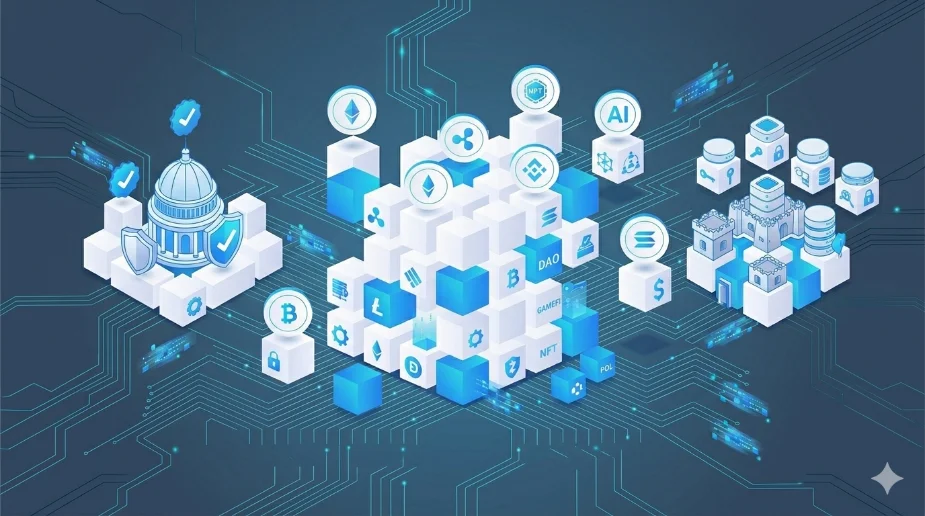
Among the 11 groups, Blockchain stands out as a critical pillar for solving the challenges of Digital Trust and Data Authentication. More than just a standalone technology, Blockchain acts as a "Proof Infrastructure," ensuring digital systems operate with transparency and security without relying on intermediaries.
This importance is amplified by Vietnam’s latest legal frameworks:
Data Law 2024: Mandates data integrity and traceability.
Personal Data Protection Law 2025: Emphasizes access control and transparency.
International Standards: Alignment with W3C DID, Verifiable Credentials (VC), and GDPR requires an infrastructure capable of cross-border verification.
Blockchain's immutability ensures that once data is confirmed, it cannot be altered. According to research by the World Economic Forum and IBM, blockchain can reduce supply chain operating costs by 20–40% and slash verification times from days to near-instantaneous results.
NDAChain – The Trusted Infrastructure for National Digital Strategy

NDAChain is the realization of blockchain technology at a national scale. Designed as strategic infrastructure, it serves essential civic services while ensuring Data Sovereignty.
Core Features of NDAChain:
High Performance: Processing between 1,200 – 3,600 transactions per second (TPS).
Advanced Security: Built-in Zero-Knowledge Proofs (ZKP) and Decentralized Identity (DID).
Global Compatibility: Fully compliant with W3C DID, Verifiable Credentials, and GDPR, enabling global integration.
Open Ecosystem: An open-source direction that allows businesses and government agencies to integrate easily without intermediary control.
From Policy to Implementation
Operating as a Layer 1 blockchain, NDAChain serves as the "backbone" connecting Layer 2 and Layer 3 solutions. It facilitates seamless data exchange between industries, creating a foundation for a transparent and sustainable digital society.
NDAChain is not just a technology; it is a strategic step for Vietnam to master its digital destiny, protect citizen data, and drive the digital economy forward.