(ndachain.vn) South Korea's decentralized identity model combines an industry-led DID alliance with a state-issued digital resident card, letting citizens control their own data and authenticate securely. The DID Alliance Korea was founded in October 2019, and by 2025 South Korea had rolled out its mobile resident registration card nationwide, from February 14 to March 14 (Korea.net). The core is a hybrid DID model that combines centralized and decentralized identity. This article analyzes how South Korea built this system, the hybrid DID model, and the lessons for Vietnam's digital identity direction and NDAChain, Vietnam's national blockchain infrastructure.

Where did South Korea's decentralized identity alliance begin?
South Korea is one of the few countries that bet early on decentralized identity (DID) as a strategic direction for managing citizen data. In October 2019, the DID Alliance Korea was formed to build a standardized, interoperable framework for decentralized identity services (Ledger Insights).
What stands out is how South Korea mobilized resources. The alliance was not built by a single government agency, but brought together major technology and financial institutions such as Samsung SDS, LG CNS, Shinhan Bank, and NH Bank, alongside security and blockchain specialists such as Raonsecure and Coinplug. This public-private alliance model enabled fast standardization and a broad acceptance network from the start.
🔑 Read more: Decentralized identity: a global trend in the digital era
The alliance's ambition was not domestic only. From the outset, South Korea aimed to take its decentralized identity standard international, targeting cross-border interoperability for digital identity and credentials.
Digital resident cards and South Korea's mobile ID journey
South Korea did not deploy digital identity in a single step. It followed a phased roadmap, gradually expanding from one credential to the whole national identity system.
Mobile driver's license: piloted in January 2022 and officially issued from July 2022, built on blockchain technology to prevent forgery. Within the first few months, by the end of November 2022 it had roughly 750,000 users.
Mobile ID: expanded into a smartphone-based identity system, but by 2025 it had reached only about 4 million users, held back by complex issuance procedures and limited use cases (Biometric Update).
Mobile resident registration card: rolled out nationwide from February 14 to March 14, 2025, coordinated by the Ministry of the Interior and Safety (MOIS) and the Presidential Committee on the Digital Platform Government, after a pilot in nine regions. Citizens receive the card by tapping their phone to a chip-embedded ID card or scanning a QR code at a community center. The same year, South Korea also launched digital resident cards for foreign residents.
🔑 Read more: What is a national blockchain? A full overview of NDAChain's architecture and ecosystem

The hybrid DID model: combining centralized and decentralized identity
The core of South Korea's approach is a hybrid DID model that combines the state's centralized authentication authority with citizens' decentralized data self-sovereignty. This is neither pure DID nor a traditional centralized model, but a reconciliation of both.
The state as the root of trust: the competent authority remains the issuer and guarantor of identity, creating a legal root of trust for the whole system.
Citizen-controlled data: personal information is encrypted and stored directly on the user's device rather than in a centralized database, reducing the risk of leaks and mass surveillance.
Only proofs are shared: when verification is needed, the user presents only the required attributes, while the raw data never leaves the device.
🔑 Read more: What makes NDAChain, Vietnam's national blockchain, special?
The hybrid approach solves a real problem: purely decentralized identity struggles to meet the legal and accountability requirements of public services, while fully centralized identity creates privacy risks and a single point of failure. The hybrid model keeps the state's root of trust while giving citizens control over their data.
🔑 Read more: The trust triangle in the decentralized identity model

Why did South Korea choose hybrid over pure DID?
The hybrid choice reflects pragmatism. A national identity system must serve tens of millions of people and connect to legally valid public services, so it cannot be entrusted entirely to a decentralized network with no clearly accountable party.
South Korea's rollout also offers a cautionary lesson. Despite launching early, mobile ID adoption remained limited to about 4 million users due to complex issuance, few use cases, and low public awareness. Good technology is necessary, but user experience and an application ecosystem are what determine adoption.
🔑 Read more: Permissioned vs Public Blockchain: why national blockchains choose the permissioned model
Lessons from South Korea for Vietnam
From how South Korea designed and deployed its decentralized identity system, four lessons can be drawn that are directly relevant to Vietnam and to NDAChain's direction.
1. The state as root of trust, citizens in control of data
South Korea's hybrid model shows that state authority and data self-sovereignty are not mutually exclusive. NDAChain follows the same logic by serving as state-led trust infrastructure, while the identity layer lets citizens control their own data.
2. Privacy by design
South Korea's choice to store encrypted data on the device and share only proofs is privacy by design. This is also how NDAChain operates, where personal data need not leave its source and only proofs are verified on-chain.
3. Standardization and interoperability from the start
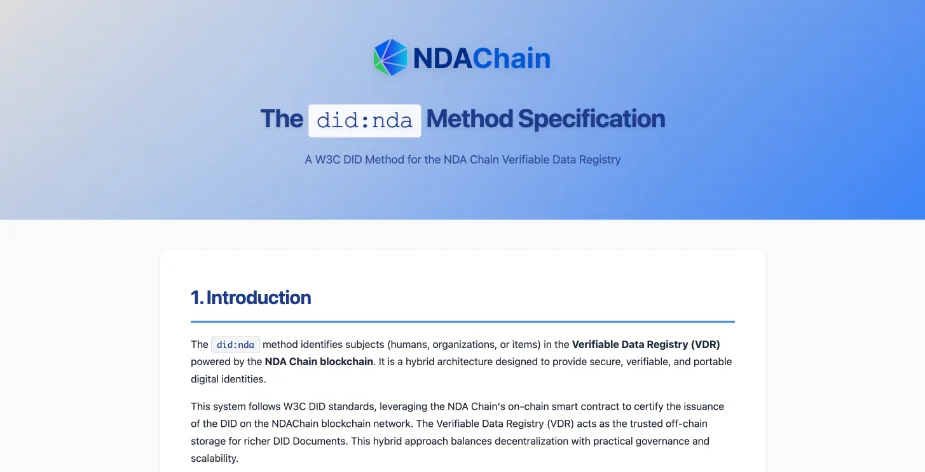
The DID Alliance Korea centered its work on an interoperable framework. Vietnam pursues a similar path with the did:nda method compliant with the W3C standard, aiming for international interoperability of digital identity and credentials.
🔑 Read more: What is W3C DID? Why the Internet needs a decentralized identity standard
4. Experience and use cases determine adoption
The clearest lesson from South Korea is that technology does not automatically drive adoption. To avoid low uptake, an identity infrastructure needs simple issuance, many real use cases, and strong communication from launch.
🔑 Read more: Thailand's NDID: a decentralized and self-sovereign identity platform in Asia
NDAChain and the hybrid DID model for Vietnam
Both South Korea and Vietnam choose to combine a state-led root of trust with citizen data self-sovereignty. NDAChain implements a W3C-standard decentralized identity layer with the did:nda method, combined with NDADID, the national decentralized identity layer, and the self-sovereign identity solution NDAKey for users and enterprises.
🔑 Read more: NDAChain puts Vietnam among Asia's pioneers in W3C DID decentralized identity
Architecturally, NDAChain combines a permissioned blockchain with data infrastructure to build national-scale digital identity, running on the PoA-qBFT consensus mechanism at roughly 1,200 to 3,600 transactions per second. This is the same hybrid spirit South Korea pursues, placed within Vietnam's governance and standardization framework.
🔑 Read more: Vietnam leads Southeast Asia in international DID interoperability under the W3C standard
The difference lies in positioning. While South Korea started from an alliance of enterprises and banks and expanded into official credentials, Vietnam places national blockchain infrastructure as a common base layer from the start, so digital identity, traceability, and public services all operate on one unified platform.
🔑 Read more: What is Digital Public Infrastructure (DPI)? The role of national blockchain NDAChain
From South Korea to Vietnam's digital identity roadmap
South Korea's decentralized identity model proves that hybrid DID is a practical path for a nation to guarantee a legal root of trust while giving citizens data self-sovereignty. At the same time, South Korea's experience is a reminder that success lies not only in technology, but in experience and the application ecosystem.
With NDAChain, Vietnam is on a similar path but with its own emphasis on national blockchain infrastructure and internationally standardized identity. Learning from countries that moved earlier, including South Korea, Estonia, the EU, and India, is how Vietnam can shorten its roadmap and avoid mistakes that have already been tested.
NDAChain is ready to accompany agencies, organizations, and enterprises exploring the hybrid DID model and its applications in digital identity, data verification, and large-scale public services. Visit ndachain.vn to discuss the technical architecture and a roadmap that fits your organization.